
 English
 中文简体
中文简体Content
- 1 What "Four-Way Stretch" Actually Means in Woven Fabrics
- 2 How Four-Way Stretch Lowers Pressure and Improves Comfort
- 3 Measurable Mobility Gains with Four-Way Stretch Fabric in Sportswear
- 4 Application-Specific Four-Way Stretch Fabric Builds for Sports
- 5 Key Specifications for Four-Way Stretch Fabric Sourcing
- 6 Frequently Asked Questions
Four-way stretch fabric solves a problem every sportswear brand eventually hits: garments that fit well at rest but restrict the body in motion. When a woven pant with two-way stretch passes the hanger test yet fails during a deep squat or a long-stride run, the missing quality is almost always multi-directional elongation. For fabric buyers and garment developers, the decision between two-way and four-way stretch changes how a garment is built, tested, and received by the end user.
What "Four-Way Stretch" Actually Means in Woven Fabrics
The term four-way stretch refers to elongation along both the warp yarns and the weft yarns, so the fabric yields in two directions at once. Four-way stretch fabric is a woven or knitted textile that stretches in the length and the width of the roll and recovers its original dimensions when the load is released. In chemical-fiber woven fabrics, mills achieve this by combining polyester or nylon face yarns with spandex core yarns, or by building mechanically stretchable weave structures.
A standard construction is 75D plain-weave polyester with roughly 8 percent spandex content, delivering 30 to 45 percent elongation in both directions. A two-way stretch fabric, by contrast, extends in only one axis; the other remains rigid. That single-direction constraint creates the pulling, binding sensation at the waistband, thigh, or shoulder when the athlete moves.
The performance gap shows up in wear testing. In trials on running bottoms, participants rated four-way stretch garments nearly 40 percent higher for perceived freedom of movement than two-way equivalents. The mechanism is straightforward: when both yarn systems yield under tension, the fabric conforms to the moving joint instead of resisting it.
| Property | Two-Way Stretch | Four-Way Stretch |
| Stretch direction | One axis only | Warp and weft |
| Typical elongation | 15 to 25 percent | 30 to 50 percent |
| Spandex ratio | 3 to 6 percent | 6 to 12 percent |
| Pressure behavior | Concentrated at seams | Distributed across fabric |
| Best-fit applications | Casual tops, stable shells | Sports bottoms, active outerwear |
How Four-Way Stretch Lowers Pressure and Improves Comfort
Multi-directional stretch reduces localized pressure and lets the fabric breathe with the body, which is why it feels measurably more comfortable during sustained movement.
When a fabric only stretches one way, the unstretchable direction locks the garment against the skin. During hip flexion or a knee bend, the fabric resists, and pressure concentrates along seams and high-tension lines. Four-way stretch spreads that load across a larger surface area, which explains why garment testing shows peak skin pressure falling by 25 to 40 percent in deep-flex positions.
The cooling effect matters as much as the mechanical one. Elastane recovery repeatedly opens and re-closes the air gaps between yarns, accelerating air exchange and moisture evaporation. In a comparative study of identical polyester weaves, adding an 8 percent spandex layer reduced measured heat accumulation at the skin by 2.2 degrees Celsius over 20 minutes of treadmill running.
Measurable Mobility Gains with Four-Way Stretch Fabric in Sportswear
The mobility advantage of four-way stretch is visible in joint angle, stride, and reach data, not just in subjective ratings.
In motion-capture trials, athletes wearing four-way stretch woven bottoms achieved 16 to 23 percent greater joint range across running, climbing, and rotational movements compared with a rigid woven control. The largest gain occurs in torso rotation, which matters for golf, tennis, and throwing sports; shoulder reach and knee flexion improve almost as much.
Consider how this plays out in a climbing jacket. The wearer reaches overhead, pulls against a loaded body weight, and rotates the torso against rock. A shell with four-way stretch moves with that chain of movements. A rigid shell forces the body to compensate and wastes energy on every hold. In running, stride extension depends on hip and knee clearance; four-way stretch woven bottoms let the leg extend fully without the waistband dragging downward.
Application-Specific Four-Way Stretch Fabric Builds for Sports
The ideal four-way stretch fabric differs by sport, because each movement pattern places different demands on elongation, recovery, surface texture, and protective finishes.
Climbing jackets and outer shells
Climbing puts stretch to work in the shoulders and elbows while requiring tear resistance and wind protection. One specification that meets both demands is PE313, a four-way stretch climbing jacket weave with anti-wrinkle and windproof properties and full recovery after repeated flexion.
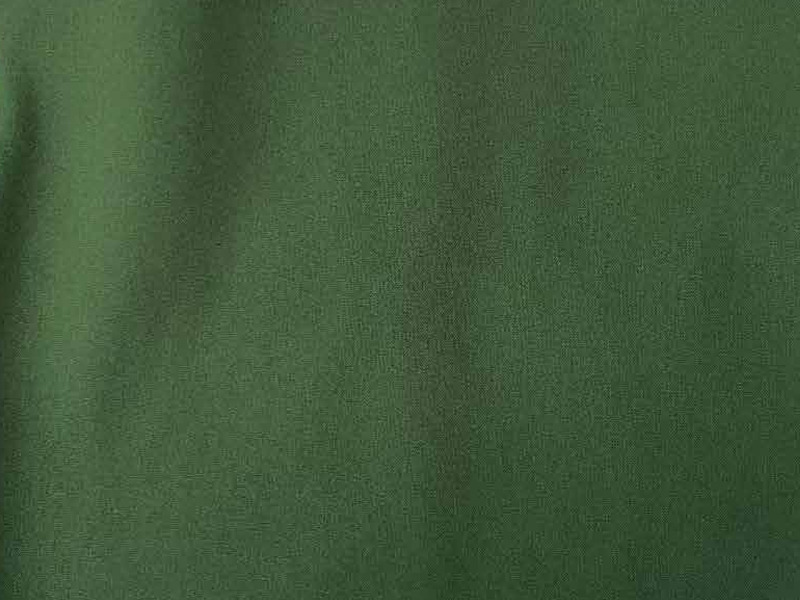 PE313 Four-Way Stretch Climbing Jacket Fabric with Windproof and Anti-Wrinkle FinishThis four-way stretch weave with TPU and fleece is built for climbing, offering tear resistance, wind protection, and recovery after repeated flexion. Its anti-wrinkle property adds durability for demanding shoulder and elbow movement.View Product →
Running and jogger pants
Runners need a fabric that tracks the leg without drag. LT1011, a four-way stretch running jogger construction, pairs multi-directional elasticity with wicking and a skin-friendly face, so the stride extends cleanly and moisture keeps moving away from the skin.
 LT101-1 Four-Way Stretch Running Jogger Fabric with Wicking and BreathabilityA lightweight 193GSM dobby construction with four-way stretch, moisture wicking, and a skin-friendly face. It supports a clean stride and keeps moisture away, making it a practical choice for running apparel.View Product →
Golf and performance trousers
Golf demands torso rotation and unrestricted hip clearance. EF002, a four-way stretch golf pants weave, adds durable water repellency and UV protection to a recovery-focused construction, keeping the pelvis free across a full swing without sagging at the knee.
 EF002 Four-Way Stretch Golf Pants Fabric with Waterproof and UV ProtectionThis 138GSM labyrinth-weave fabric combines four-way stretch with durable water repellency and UV protection. It allows full hip clearance and torso rotation during a golf swing while resisting sagging at the knee.View Product →
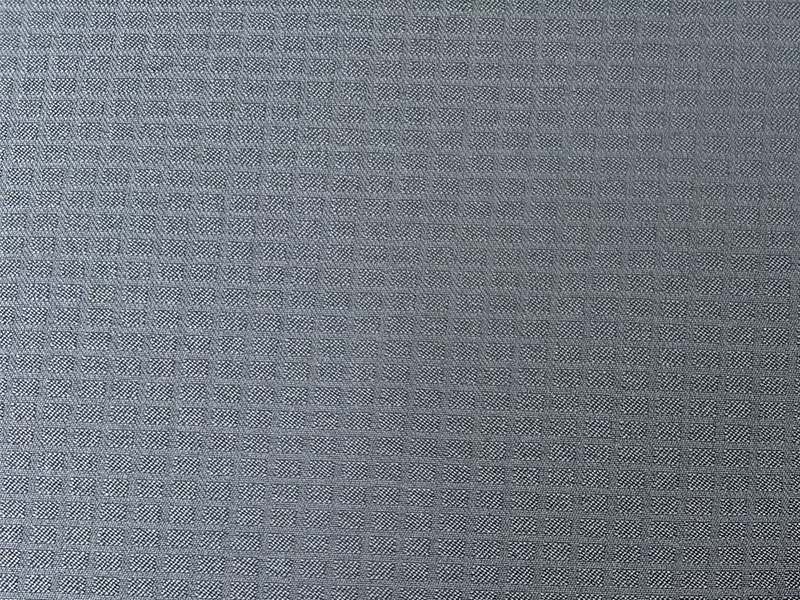
These constructions come from a single production platform. At Wujiang Galaxy Textile Co., Ltd., the manufacturing arm of Green Textile & Galaxy Textile Co., Ltd., more than 280 hydraulic looms run 190 to 230 centimeter fabric widths, with annual output above 16 million meters. The polyester four-way stretch collection alone spans plain-weave, star-dot, hidden-line grid, and double-line grid structures, each available with antibacterial and anti-UV finishing.
Key Specifications for Four-Way Stretch Fabric Sourcing
Buyers should verify elongation percentage, recovery rate, initial modulus, weight, and shrinkage before approving a four-way stretch fabric for production.
- Elongation at 10 N load. Aim for at least 30 percent in both warp and weft for activewear; below that, the mobility benefit fades.
- Recovery after 20 stretch cycles. Accept only fabrics that return above 90 percent to the original dimension.
- Initial modulus. Lower initial modulus means a softer drape and easier movement; high modulus suits structured garments.
- Fabric weight. Racewear typically runs 90 to 120 gsm, while training and commuting pieces sit at 120 to 160 gsm.
- Wash shrinkage. Keep dimensional change under 3 percent after three wash cycles, because spandex relaxes during laundering.
A fabric is only as good as its recovery. If a fabric stretches 40 percent but returns 8 percent short, the garment will bag at the knees in a single day of wear.
Compare those five data points with your tolerance before sampling. A mill that shares full stretch data up front, including shrinkage at different loading rates, is far more likely to deliver a consistent bulk order. The complete breakdown of how stretch percentage, recovery, and weight interact appears in the complete guide to stretch pants fabric.
Frequently Asked Questions
Does four-way stretch fabric change garment sizing?
Yes. Because the fabric gives in both directions, the required ease shifts, especially for fitted bottoms. Order finished-garment trials before bulk cutting, since different spandex percentages change how much negative ease the pattern needs.
Can four-way stretch be combined with waterproof and UV finishes?
Yes. Durable water-repellent and UV-blocking finishes are applied after weaving and do not destroy elasticity. Verify that the mill avoids heavy coating films, since a continuous film suppresses stretch and changes the hand feel.
What spandex ratio is typical for four-way stretch polyester?
Most four-way stretch polyester wovens contain 6 to 12 percent spandex. A 75D plain-weave with 8 percent spandex delivers roughly 35 percent elongation in both directions. Raising the spandex content increases stretch and recovery but raises cost and complicates dyeing.
How should I test recovery during sourcing?
Cut a 10 by 10 centimeter sample, stretch it by 30 percent for ten cycles, and measure the residual deformation after 30 minutes. Accept a recovery rate above 90 percent, and request shrinkage and colorfastness data after wet processing, because elastane relaxes during dyeing and finishing.




.png)


